
Can Free Will Make Sense?
Robert Sapolsky vs. Kevin Mitchell

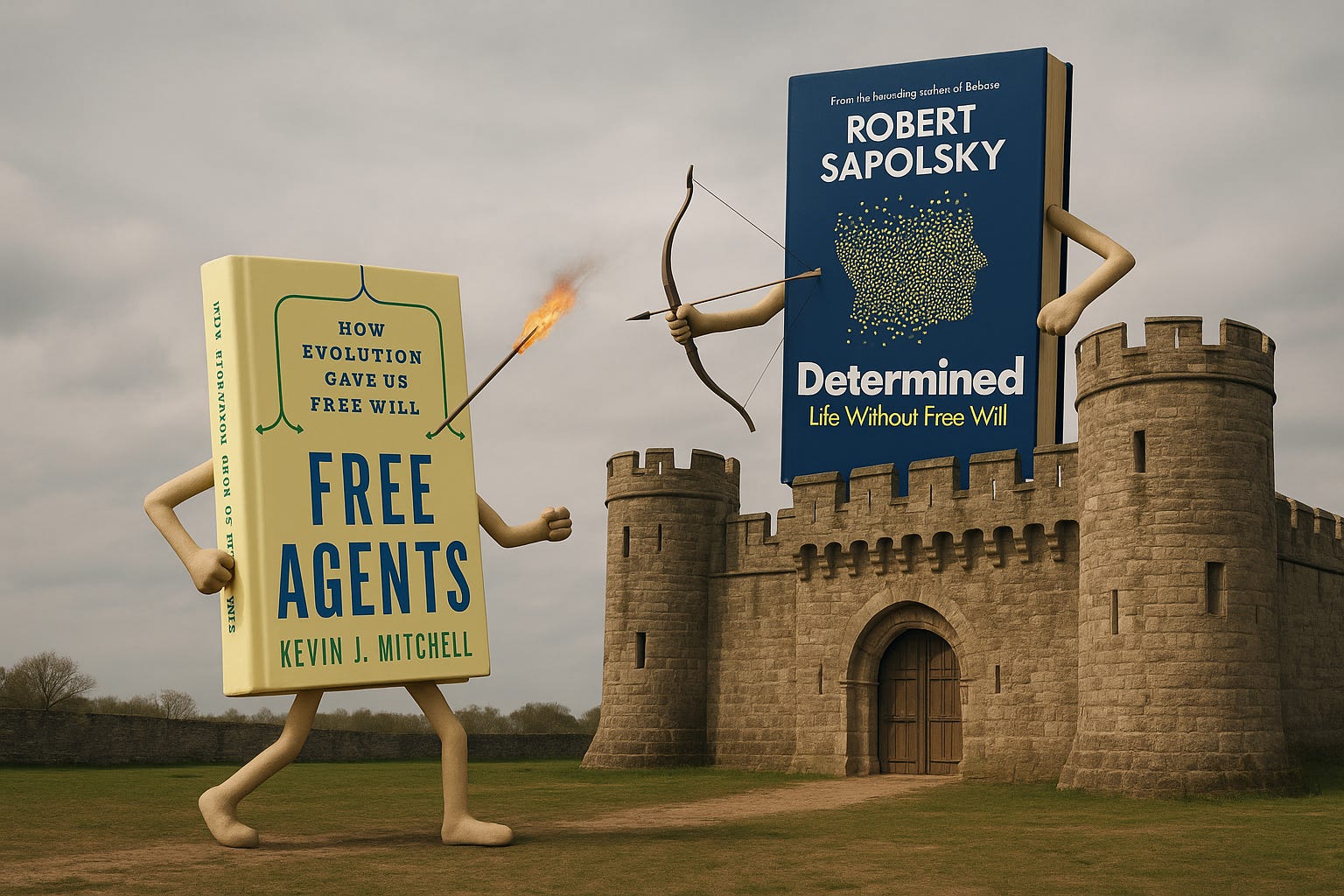
The Battlefield
The next Book Battle is over the age-old philosophical conundrum of free will, pitting against each other the two most recent, comprehensive and, crucially, the most scientific arguments on each side of this debate: Robert Sapolsky’s Determined: Life without Free Will and Kevin Mitchell’s Free Agents: How Evolution Gave us Free Will.
As with all these Book Battles, my job as the arbiter isn’t to say who’s right or wrong and give a definitive answer to the debate. It’s to explain which of the books I found more convincing and why. Of course, I also hope my review will help to elucidate the debate itself, and if I’m not falling victim to my own biases and delusions (always a possibility), point towards the truth in some roundabout way.
The free will debate all boils down to a single question. When you make a choice, are you in control of that choice, as an independent causal agent in the universe (even if just a little bit), or are your decisions always fully determined by other things outside of your control? Or, to put it another way: Do your conscious decisions interfere in the unfolding causal chain of the universe, or are they just a part of that chain, like everything else that happens around you in the material world? (FYI, for any free will debate aficionados out there, we’re not concerned with the “compatibilist” view here; it’s either libertarian free will or determinism, nothing in between).
Let’s take a minute and think about something you might find relevant, like your life. Pretend that you’re on your death bed. Now think about all your most important achievements, the things that make you proud – the company you built, your net worth, your acts of charity, your six pack, your straight-A, well-behaved children, that delicious sandwich you once made, how much cats like you… whatever, fill in the blank. Can you take pride in those achievements as evidence of your own intrinsic effort and grit and self-ordained power to make decisions and act upon the world? Or should you look upon your achievements with humble gratitude and admit that it all, ultimately, boiled down to luck?
Or, to take the other angle, look back at the things you wish you’d done differently, the times that you let yourself down or hurt somebody, the lost opportunities, the broken relationships, the string of murders you committed while disguised as a clown, whatever. Should you fully own those mistakes, taking personal responsibility and accepting shame and guilt as just rewards? Or can you feel free to offload those negative emotions onto the omnipotent excuse that you could not have done otherwise?
These are big, difficult questions, but surely they must haunt us all at some level. On the other hand, some people somewhere might be so inclined as to take personal credit for their achievements and blame failures on factors outside of their control, like poor sleep, hormones, childhood trauma or a mental disorder, but obvs you would never do that.
Ok, now I’ll get in the hot seat. I promised in my introductory post that I would be up front about my priors and cognitive biases as the trusted arbiter of these Book Battles. So, I must admit that for the past few years I’ve been a fairly enthusiastic advocate of the free-will-doesn’t-exist position. I was persuaded to this view by the neuroscientist/philosopher/etc. Sam Harris. I won’t get into his arguments, since this review’s not about him, but suffice to say that he had me pretty convinced that both free will and the self were just illusions, two sides of the same coin, and I started to think that the science was pretty much settled. Claims to the contrary were relics of unenlightened medieval metaphysics and dualist crackpottery. So, when I first read Sapolsky’s Determined (as well as its prequel, Behave), I assumed that he would add a bit of scientific nuance to the anti-free will argument that I had already bought into hook, line and sinker; and I can report that this was a highly successful exercise in confirmation bias.
In order to challenge this position, I decided to read Mitchell’s Free Agents, which purports to make a purely scientific argument in favor of free will. Mitchell’s book has been well reviewed and a few academics I follow have said they found the argument convincing. I’ve also (belatedly) discovered four other comparative reviews of the two books online, two of which are more persuaded by Mitchell than Sapolsky (of the other two, one favors Sapolsky while the other calls it a draw). So, if anyone’s going to convince me that Sapolsky’s wrong about free will, Mitchell seems like the one to do it.
Let’s start with Sapolsky’s argument, which, as I see it, builds up a sort of logical fortress around the determinist position. Conveniently, he also explains precisely what kind of a counterargument would refute this position by showing how free will could be real. Then I’ll summarize Mitchell’s argument and we’ll see whether he successfully meets the challenge by breaking through Sapolsky’s fortress walls and shifting my priors.
Sapolsky’s fortress
This is pretty straightforward. If any decision you take can be fully explained as the effect of prior causes that are beyond your control, then it follows that there is no room for free will. Full stop. No wiggle room for “you”, your self, your soul, your mystical life force, to intervene in the unbroken chain of causation and alter the natural flow of events.
So what are those prior causes that are beyond your control? They are different types of processes that were happening inside you, in your upbringing, in your culture, in your genes, during different times leading up to when you made your fateful choice, whatever that happened to be. If you appreciate a good list, here are Sapolsky’s ten factors:
1) What was happening in your brain a split-second to seconds before you make the decision? E.g. activity of your brain cells that indicates an intended action, which can be detected up to 10 seconds prior to you realizing you’ve decided to do it.
2) What was happening seconds to minutes before? E.g. the emotional responses in the amygdala region of your brain, which were unconsciously triggered by what was going on in your sensory environment.
3) Minutes to days before, e.g. the hormones circulating in your bloodstream that affect your brain activity and make you more prone to certain types of behavior.
4) Weeks to years before, e.g. things like stress, trauma, depression and parenting affect the way your neurons branch and form connections over time, transforming brain regions and adjusting the thresholds for your emotional and behavioral responses.
5) What happened to you during your adolescence, when your experiences shape your developing frontal cortex, which plays a central role in things like long-term planning, impulse control and emotional regulation.
6) During your childhood, when everything else in your developing brain – and by extension your personality – are shaped by things like parenting styles, peer groups, your environment, your culture, diet, trauma, etc.
7) What was going on while you were in the womb, e.g. the hormones, nutrients, toxins, drugs, etc. that were circulating through your mother’s system and affected the development of your fetal brain, potentially making you more prone to depression, aggression, alcoholism, poor emotion regulation, schizophrenia, etc.
8) The genes you received from your parents, which interact with environmental factors to determine what proteins to produce in order to make all the cells in your body and determine everything they do, which in turn affects who you are and everything you do.
9) The type of culture your ancestors lived in centuries ago, because the cultural values and practices of the family and community into which you were born evolved over centuries and influenced how you were raised, what values you hold and what you think of as normal behavior.
10) The whole course of biological evolution, because you’re (presumably) a human, and humans have evolved to behave differently from marmosets, oak trees and whatnot.
There you have the core of Sapolsky’s argument against free will: ten causal factors from different times in your life and before that influence your behavior (although there’s obviously much more to his book than this list).
Those causal factors pertain to a variety of different “buckets”, which is what he calls academic disciplines: neuroscience, psychology, endocrinology, developmental biology, genetics, anthropology. No single bucket can be said to fully account for what you do. Each one provides only partial description of behavioral causation, which is why someone can usually make a strong case for free will in the face of any scientific argument from a single discipline. It’s true that we’re not fully determined by our genes, or our upbringing, or our culture. But for Sapolsky, all the factors together create a “seamless” history of cause and effect, one thing beyond your control leading to another thing beyond your control leading to another … like dominoes, or clockwork, or any other mechanical or physical process you can imagine. Except in this case, the outcome of that deterministic chain of events is everything you’ve ever thought you chose to think, say or do.
Sapolsky’s challenge to any would-be prover of the existence of free will is simple, and it’s worth quoting: “Show me where one of these explanations breaks down, and some behavior just happened out of thin air. […] Show me a neuron (or brain) whose generation of a behavior is independent of the sum of its biological past. Show me […] a causeless cause.”
That’s a pretty precise statement of what would be required to take down his argument. Simply show something that an organism does that is not fully determined by other stuff going on outside of its control. Let’s see if Mitchell has what it takes.
Mitchell’s secret weapon
I’ll cut to the chase. Mitchell’s secret weapon, his answer to Sapolsky’s challenge, is a human self that’s capable of conscious, rational control. At first glance this seems both vague (what’s a “self”?) and tautological (doesn’t free will presume control?). But Mitchell’s point is quite profound, and he gets there via a pretty long and complicated scientific argument, which, like Sapolsky’s, crosses disciplinary boundaries. I’m going to do my best to summarize it briefly, and in more or less plain English.
But before we get to free will, we have to start with his more general concept of agency. For Mitchell, all living things, all the way down to single-celled amoebas, are agents, which means that they “can take action, make decisions, and be a causal force in the world” (if that sounds like free will to you, you’re not alone). But Mitchell defines free will more narrowly to mean “conscious, rational control” over those actions and decisions. And that requires specifically human faculties, like reflective thought, metacognition and language. Essentially, while all organisms act for reasons, only humans are able to reason about reasons, and this adds a layer of self-determination that other organisms don’t have.
Top-down Causation
Mitchell’s understanding of free will is centered on a particular idea of top-down causation. This is the idea that when you have a certain type of complex system – like an organism – which is made of many smaller parts – like particles, atoms, proteins, cells, etc. – the system’s behavior as a whole is not fully determined by the behavior of the smaller parts. In fact, the complex system at the macro level can affect what the smaller parts do at the micro level.
Top-down causation goes against a tendency in science to explain a complex system by describing what its minute components are doing, i.e. reductionism. For a proper reductionist, psychology (human minds) is really just biology (cells and organs), which is, at bottom, really just physics (atoms and particles) doing complex stuff. But Mitchell says, no! Biology brings something into the world that is wholly new and can’t be reduced to physics. Living organisms are complex systems that play an essential role at the macro level in driving causation that is not explainable by micro-level physical processes.
For some complex organisms, specifically, animals with central nervous systems, this top-down causation plays out in the form of information processing in the brain. Animals accumulate information over time, some of it passed down through genes and some of it learned through experience. Their brains process this information to form models of the world and their selves, which they draw upon whenever they need to make a decision, consciously or otherwise. So for a hunting lion, its world model might include things like gazelles, their typical behavior, speed, endurance, the type of terrain they’re liable to run across, etc. And its self model includes its own body, sensations like hunger, its own physical capacities, current position, any sounds it’s making, etc. It draws on both these informational models in order to make decisions about how to stalk and attack a gazelle.
Crucially for Mitchell, the information in these models has causal power. And by harnessing it, animals are not merely pushed around by energy according to the laws of physics, like any old inanimate object. They do things for reasons, e.g, to satisfy hunger, to survive. They have agency.
But for full-blown free will, Mitchell requires another level of top-down control, which is made possible in large part by humans’ unique language abilities. Language gives you powers of abstract, rational thought and reflection that other animals lack. It enables you to think about your own thinking, set long-term goals, deliberate about what you ought to do, understand your own motivations, and whatnot. It also allows you to give your life narrative structure and construct a coherent idea of your self – who you are, what you’re like, what you stand for. This self-constructed self, a “recursive loop”, is what is responsible for the ultimate type of top-down causation which Mitchell calls free will.
The core of Mitchell’s argument is that you use information to behave in ways that aren’t fully determined by the laws of physics. But he’s not saying that you violate the laws of physics or do something supernatural whenever you make a decision. Everything going on inside your brain has to obey physical laws, but the laws leave some wiggle room for you to influence what’s going on.
To evaluate whether Mitchell’s free will argument actually makes sense, we’re going to have to dig into this idea of wiggle room at the levels of both physics and neuroscience. Bear with me!
Wiggle Room
Mitchell finds this wiggle room in a very familiar place for finding wiggle room (at least when it comes to physics): the mysteries of quantum mechanics. Here’s an absolutely absurdly simplified description of one of those mysteries.
With very small subatomic particles like electrons, physicists have so far only been able to describe their behavior probabilistically. They can’t tell for certain what a particle is doing; they can only predict the probability that it is doing one thing or another (until they actually measure it and suddenly it takes definite form). This has led many physicists conclude that, at the most fundamental level of reality, everything is just probabilistic – indefinite, random, fuzzy, indeterminate – and that’s all there is to it, until somebody happens to measure it.
This is a controversial conclusion, which we’ll come back to. But it does imply that there’s some wiggle room, or causal slack, in the unfolding of physical events. If there were not, then everything that happens would by definition be fully determined by everything that came before, going all the way back to the beginning of the universe. And you’d just be a helpless part of that unfolding reality. But if there is causal slack, then maybe free will is at least conceivable.
Assuming quantum mechanics creates the requisite causal slack, the next question is, how is anyone meant to grab hold of that slack in order to freely make decisions? Thankfully, Mitchell doesn’t say that you control subatomic particles and pull reality around by the toe. At least not exactly. Rather, he says the indeterminacy at the quantum level “bubbles up” to the level of neuronal activity in your brain, and that’s where you can have an impact.
So here’s the crux of his argument (hold on tight!). Your decisions rest on the balance of extremely delicate neuronal fluctuations, and you can tip the scales to one option or the other with your own free will. Physics allows you to do this by means of top-down causation, where a complex system (you) influences its smaller parts; and because quantum mechanics means not everything is predetermined, there’s slack in the causal chain, wiggle room for you to act. And psychology enables you to do this by means of the self you’ve constructed with its goals, rationality and reflective thinking. These cognitive tools give you the ability to bias your neural dynamics in favor of your preferred option. These are the scientific foundations of free will. According to Mitchell.
Wait a second… How the F does your self manage to mentally reach down via reflective thought into the dynamic neural architecture of your brain and exercise control over those quantum-affected neural fluctuations in order to tip the balance between one choice and another?
Good question.
The Verdict: Weapon Failure!
The most obvious problems in Mitchell’s argument arise when we interrogate his explanation of causal slack in the universe and how human selves are supposed to harness it.
As we’ve discussed, his argument rests on the idea that the physical world is fundamentally indeterminate due to quantum mechanics. He even goes so far as to claim that quantum mechanics has “refuted determinism”. But in fact, the science around the fundamentals of quantum mechanics remains very much unsettled. According to a recent Gizmodo survey of quantum physicists, 61% believe in indeterministic interpretations, 24% in deterministic ones and 15% don’t know what they believe. This looks ok for Mitchell, until you realize that the same survey also asked these physicists about their level of confidence in their chosen interpretation, and most of them indicated that they are not very confident at all. This means that the jury is very much still out within the scientific community about what’s going on down there at the quantum level. So, when Mitchell asserts that quantum mechanics shows us that “the model of complete physical determinism […] is dead!!” (ok, my italics and exclamations) it sets off all the alarm bells for epistemic overconfidence, which is a major faux pas in the Book Battles.
But even if Mitchell happens to be right about quantum indeterminacy, we’re still left with the problem of how people harness it to make free choices after it supposedly bubbles up to the level of neuronal activity. How does the human self, which is constructed and persists over time, reach down and mess with delicate neuronal events at the molecular level? As a matter of fact, this is one point on which Sapolsky (welcome back, my friend) addresses Mitchell directly in Determined, referring to an earlier article in which Mitchell began to lay out his theory. Sapolsky conveys my sentiments exactly when he states: “Amid those issues, the biggest challenge I have in evaluating this idea is that it is truly difficult to understand exactly what is being suggested.”
Mitchell’s arguments on this point are so multifaceted and convoluted that it renders them utterly unpersuasive, if you actually attempt to make sense of them. Of course, it’s possible that both Sapolsky and I have failed in this task because of our mental feebleness or cognitive bias. Or maybe the science is sound, but Mitchell has failed to explain it in a cogent way. But the most likely problem here, I think, is that there is simply no sense to be made of free will from a scientific perspective. Mitchell, for all his valiant effort, is trying to make a silk purse out of a sow’s ear.
Sapolsky’s argument, on the other hand, that free will does not and cannot conceivably exist – at least not in a universe where matter, life and minds function according to the scientific models we’ve so far managed to develop – makes perfect sense. By pointing to all the different ways that our decisions are influenced by factors beyond our control (and by refuting the various arguments made in favor of free will – something I didn’t get to in my summary), he demonstrates how our decisions can reasonably be conceived like all the inanimate mechanical processes we see happening around us, as part of the infinitely complex, unfolding causal chains of the universe.
It really does look as if, to use Sapolsky’s favorite metaphor, “it’s all turtles, all the way down”, going back to every cause at every level in every event of your life, and those of your ancestors, and all the matter that comprises them, and the things around them, and the creation of the universe. Sure, there may be some indeterminate randomness in there from quantum mechanics, but neither Mitchell nor anyone else has shown how that randomness could possibly allow you to choose freely. As far as I can tell, to do so would be magic.
While Sapolsky probably hasn’t ended the free will debate once and for all, he’s shifted the burden of proof to the free will advocate, to show how the basic causal chain, the stack of turtles, doesn’t hold. Where is uncaused cause? Where is the neuron/brain/organism/self that moves in a way that is not fully determined by prior causes outside of your control?
What do you think? Is there anything I’m missing? Do you know of any more coherent defenses of free will? The comment section is yours. Will yourself to write one.
I wish you'd given Sapolsky some more pushback, but you were pretty clear about where you're coming from, so it isn't the worst thing in the world. I'd like to question his premise. Why is it only possible for free will to exist through the breakage of fundamental laws of the universe? Why is that treated as a remotely reasonable expectation from his side? Why does something as fundamental, flexible, and pervasive as causation have to be usurped in order for free will to exist? Mitchell may make dubious claims about how fully he understands the implications of quantum mechanics, but Sapolsky expects us to become literal reality warping gods before he'll allow free will to exist.
To try and reset the frame, try looking at free will as a meter, rather than a switch. A 'Free-will-o-meter' actually makes more sense than a strict binary, in my experience. Amoeba have more free will than rocks, but less than humans. Humans have less free will than omnipotent beings of infinite creation, but that doesn't mean we don't have free will, and it certainly doesn't mean we can't gain more of it based on how we interact with the world. Unlike amoeba or rocks, humans are capable of comprehending our evolutionary history, our hormonal and neuronal state, our culture and upbringing, and incorporating those into our decision making. This means we have more control over the decisions we make than amoeba or rocks. We have more free will. But Sapolsky (if I'm reading him correctly from your description) doesn't view this as evidence in favor of free will, he instead views it as further evidence against it. He only sees more causal lines which force humans to make such and such a decision. That's the issue with his entire premise. He sees free will as a binary, and all of the necessary complexity which contributes towards an increase in the free-will-o-meter only serves to highlight how humans aren't at the absolute maximum. More free will leads to less free will, because a greater capacity to understand and shape the world around us necessarily leads to a greater capacity to understand the things we cannot shape. But an inability to shape certain facets of the universe does not invalidate free will. You cannot ignore all the things that we are able to shape which were previously impossible, and fixate on the things which currently seem to be impossible, and say that free will doesn't exist!
Okay, sorry, wow. It's getting late, I could probably go on, but I need to sleep. This was interesting, thank you for posting it. Hope there was something in my rant up there that was worthwhile, and my apologies if there isn't, I love rambling about this stuff.
I've read Sapolsky. I haven't read Mitchell.
Two points: First: One is not required to believe in causality as Sapolsky so defines it. In his version, a given state must always lead to one and only one next state, and so can be said to cause or determine it. But this might not be the case. Imagine that God duplicated the entire universe down to the last subatomic particle and its position. Completely identical. And then you wait a bit. If Sapolsky-type hard determinism is true, then the two universes will continue to be identical forever more. But if at many points along the way the next step is only one of several possibilities, which we can only know in a probabilistic fashion, then the two universes will begin to diverge. This isn't enough to get you to free will, but if it is possible to influence the possibilities then you can get somewhere close enough.
Second: The evolutionary argument in favour of the existence of Free Will is the whole existence of natural selection. Various modifications make an organism "more fit", i.e. survive and leave more descendants than those that don't have the modification. A great many of these modifications give better perceptions, and better cognitive abilities. Now, if all of this is in the service of making better decisions -- see the tiger! don't get eaten! -- this all makes perfect sense. But only if you actually could make the decision the other way. A world where every decision had to be what it was, is one where there is no need to develop complex organisms at all. Why would we have them? What's the point of a tiger?